Everything your restaurant needs online, all in one place, run for you.
A website built to rank on Google. A phone that gets answered at midnight. A menu guests can taste before they order. An engine that fills the nights you would rather not talk about. And one console holding all of it — run with you, as a partnership, not another dashboard you are left to manage alone.
One monthly fee, all inNo setup feeLive in 5 business daysMonthly rolling
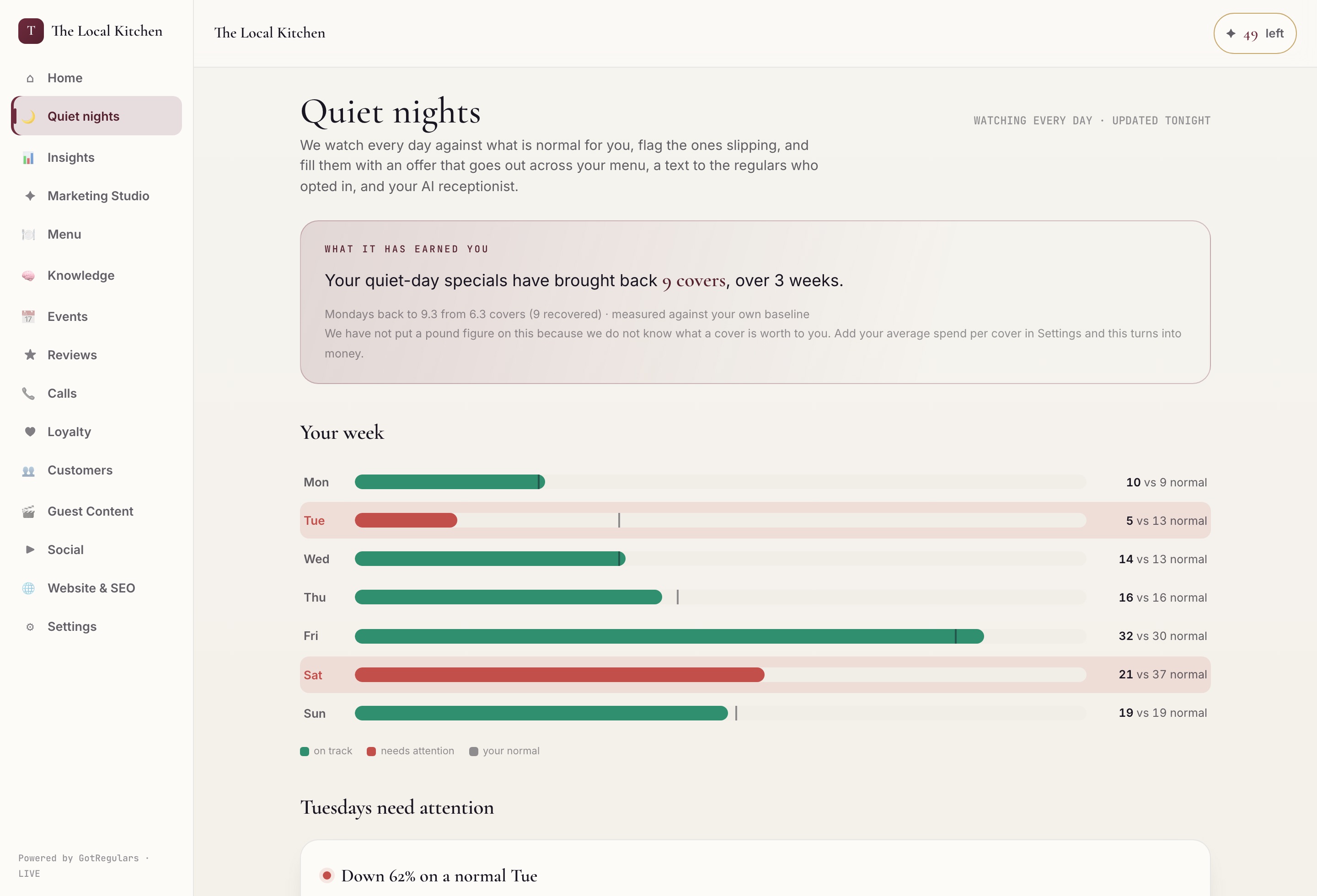
The quiet-nights engineYour week against your own baseline — page 7. Photographed live, like every screen in this pack.Demonstration build · example data
GotRegulars · The Regulars SystemRead this page if you read nothing else
Sixty seconds
Get found by the people already searching for somewhere to eat in your town — without learning a single thing about SEO.
Three things fill a restaurant: people finding you, someone answering when they call, and something worth coming out for on a wet Tuesday. Most independents have five disconnected tools and none of the three. This is all three, joined up, run for you.
01 · Be found
Where guests actually look
A site built to rank on Google — and readable by the AI assistants people now ask where to eat. Measured, scored, and re-scored with every report we run for you.
02 · Always answer
The call you cannot take
An AI receptionist answers around the clock, books the table into your diary, and texts the guest to confirm. It only ever books what your diary allows.
03 · Fill the gaps
The nights that lose money
We learn what normal looks like for you, flag the days slipping, and fill them — offer on the menu, text to your regulars, post on Google.
One fee
a month, all in
£0
setup fee
5 days
business days to live
Monthly rolling — cancel any time. Your data and any number you already owned are yours whether you stay or go.
The first fifty venues are the founding cohort we are building this company with. The rate you join at is written into your order confirmation and never rises while your subscription runs unbroken — it is in our terms, and page 13 has it in full.
How to read the rest of this
Every screen in this pack is a photograph of the live product, taken the day this edition was made. None of it is a mock-up. The two venues you will see — The Copper Fox and The Local Kitchen — are demonstration builds of our own, filled with example data and labelled as such wherever they appear. Nothing here is borrowed and nothing is invented: no name, no testimonial, no case study. Page 3 is the report we run on your restaurant, free, before you decide anything; pages 4 to 12 are the product, screen by screen; pages 13 and 14 are the money, the guarantees, and the claims we refuse to make; page 15 is straight answers; page 16 is what happens if you say yes.
The Regulars System2
GotRegulars · The Regulars SystemWhy we called
The reason for the call
Your website was built for a Google that no longer exists.
People now ask Google's AI, and ChatGPT, where to eat tonight — and those tools often never open your site at all. That is not a failure of your restaurant. It is a failure of the thing you were sold.
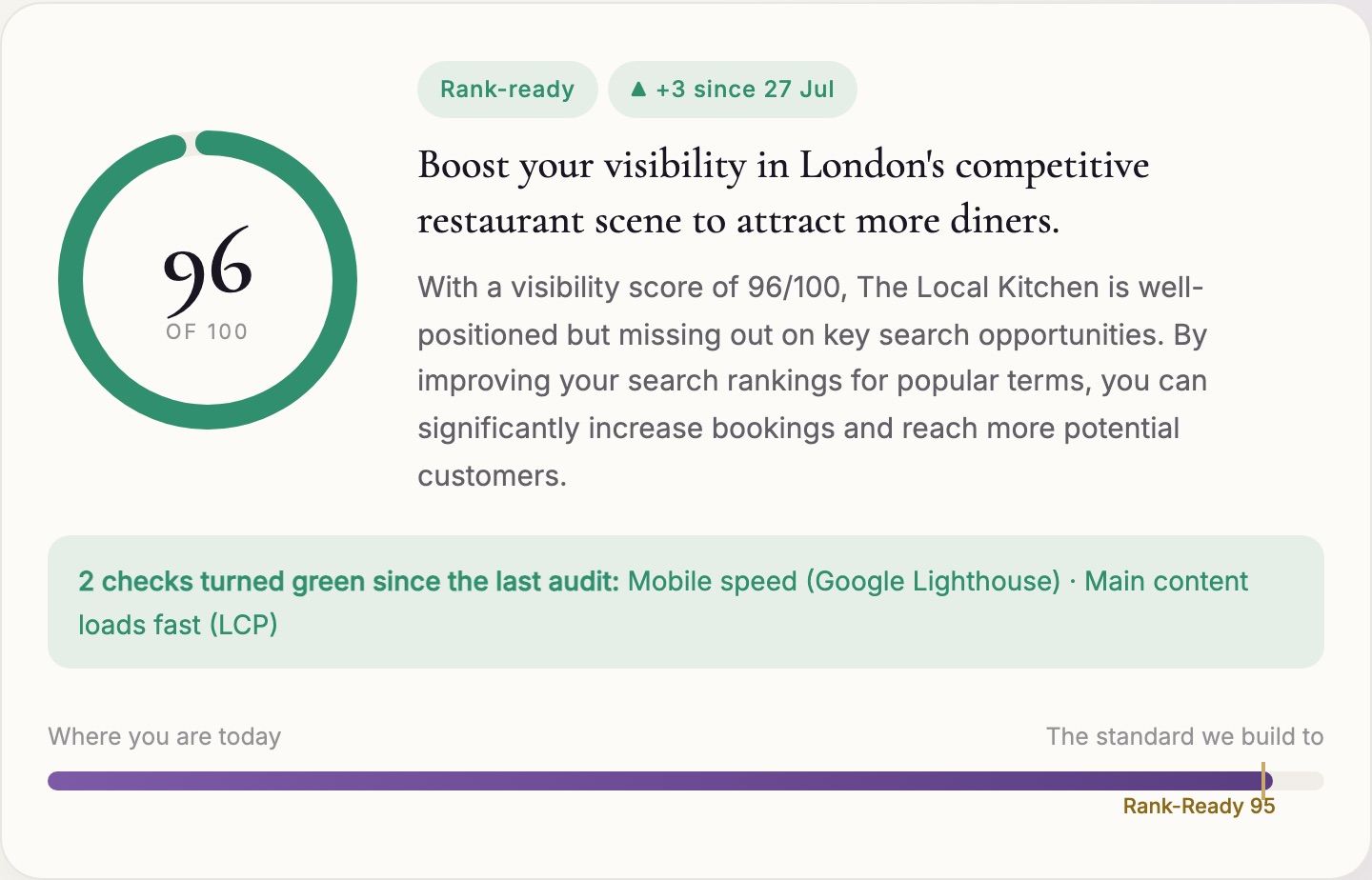
Your free visibility report. A score out of 100 for how findable you actually are, the three things costing you bookings, the real monthly search volumes in your town, and who is taking the searches you are not. Example venue data
How we found you is no mystery either: every UK food business sits on the Food Standards Agency register, which is public. When we counted that register across London's 33 boroughs in August 2026, roughly three in four of the 27,171 restaurants and cafés on it were independents like you. You are not a niche. You are the market.
What we measure
Speed & experience — what a guest on 4G actually waits for. Search foundations — whether Google can read what you sell. Local signals — your map presence and your Google profile. AI readability — whether GPTBot, OAI‑SearchBot, ClaudeBot, PerplexityBot and Google‑Extended can read your menu at all. The market — real search volumes for your town, and who ranks above you.
The rule we hold ourselves to
Any check we could not measure on the day is excluded from your score, not guessed. Every method is published at gotregulars.com/audit-methodology, so you can check our working — or hand the report to whoever built your site and have them fix it. The checks are run by hand, so a check today lands in this week's batch.
The report is yours either way. Whether we ever speak again, you keep it and the fix list. There is nothing to sign to get it.
And the part nobody says out loud
Every fix in that report is fixable without us. Most need a developer, and the rest need someone publishing something every week, forever.
The reason independents do not do it is not that they do not know. It is that you are in the kitchen at seven o'clock. That is what your monthly fee buys — someone doing it.
The free report3
GotRegulars · The Regulars SystemWhat Google reads
Module · Premium website + SEO
A website built to be quoted — by Google, and by the assistants people ask now.
Your site rebuilt from your own menu, in your own colours, structured so Google and the AI assistants can quote you. The booking is on the page, the menu is on the page, and every dish is photographed.
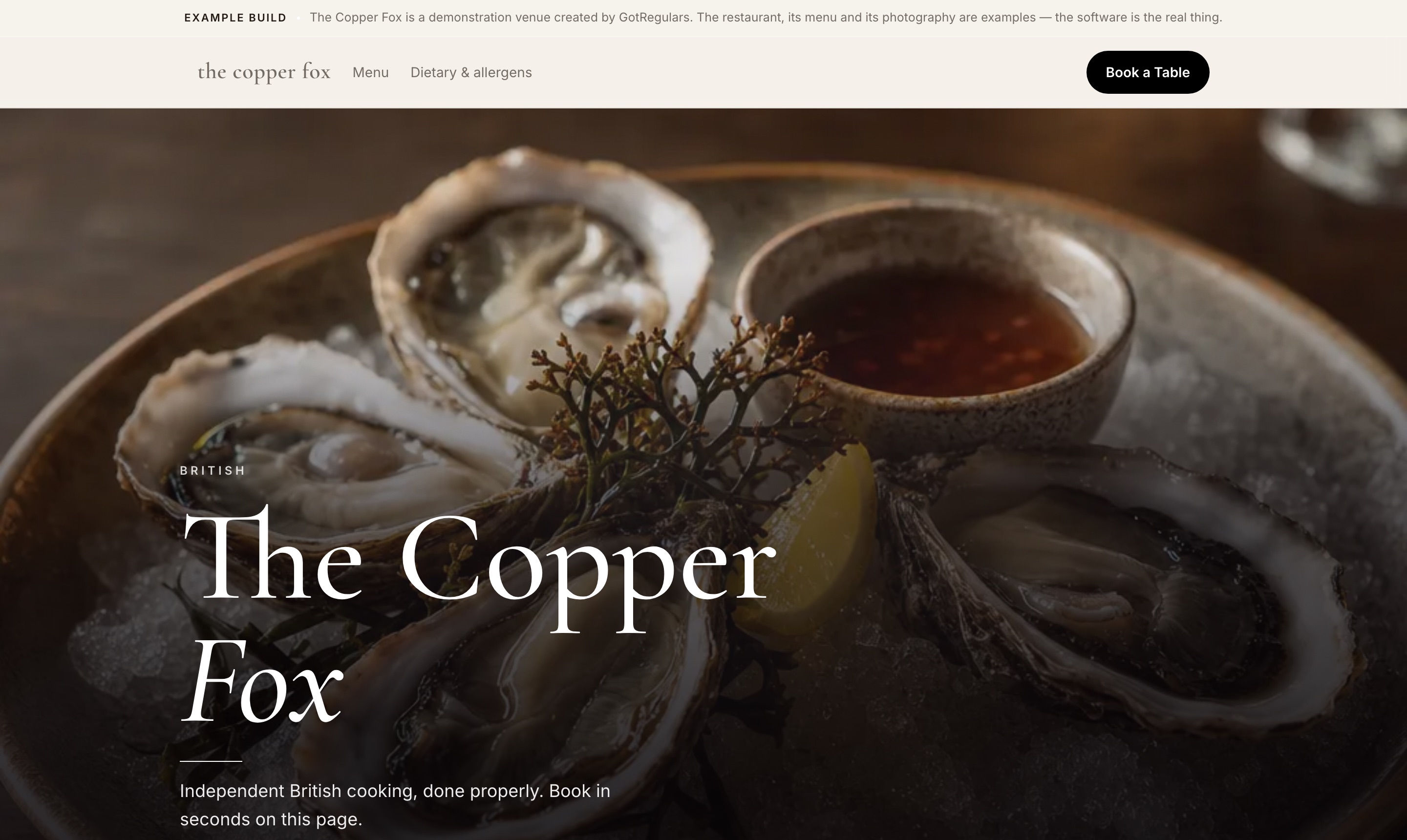
The demonstration build, photographed live. One page carries the booking, the menu and the story — and its top banner says plainly that it is an example build. Candour is the house style, on our screens as much as in this pack. Demonstration venue
Why most restaurant sites lose — measured on our own
Most are heavy, and machines give up before guests do. We know exactly how bad it gets because we measured our own first demonstration build: 126.8 MB for one menu — the last dish photo arrived after 12.8 seconds on a data-centre link, which is roughly 3.4 minutes of a real guest's allowance to read a menu. Most independent sites are built exactly that way.
What we did about it, measured
That measurement became the media contract every site we ship is now built under. The same dish photo, before and after — measured, not estimated — and dish reels rebuilt to about a fifth of the bytes at a measured quality score of SSIM 0.98. Speed is then scored by Google's own PageSpeed test, and the Rank-Ready Standard we build to is 95.
And underneath, the part you never see: your hours, your menu, your dishes and your prices written into structured data the way Google's own documentation asks for it — so the machines that answer "where should we eat tonight?" can read what you sell instead of skipping you.
The website4
GotRegulars · The Regulars SystemWhat the guest sees
Module · Interactive menu + QR ordering
A menu guests can taste before they order.
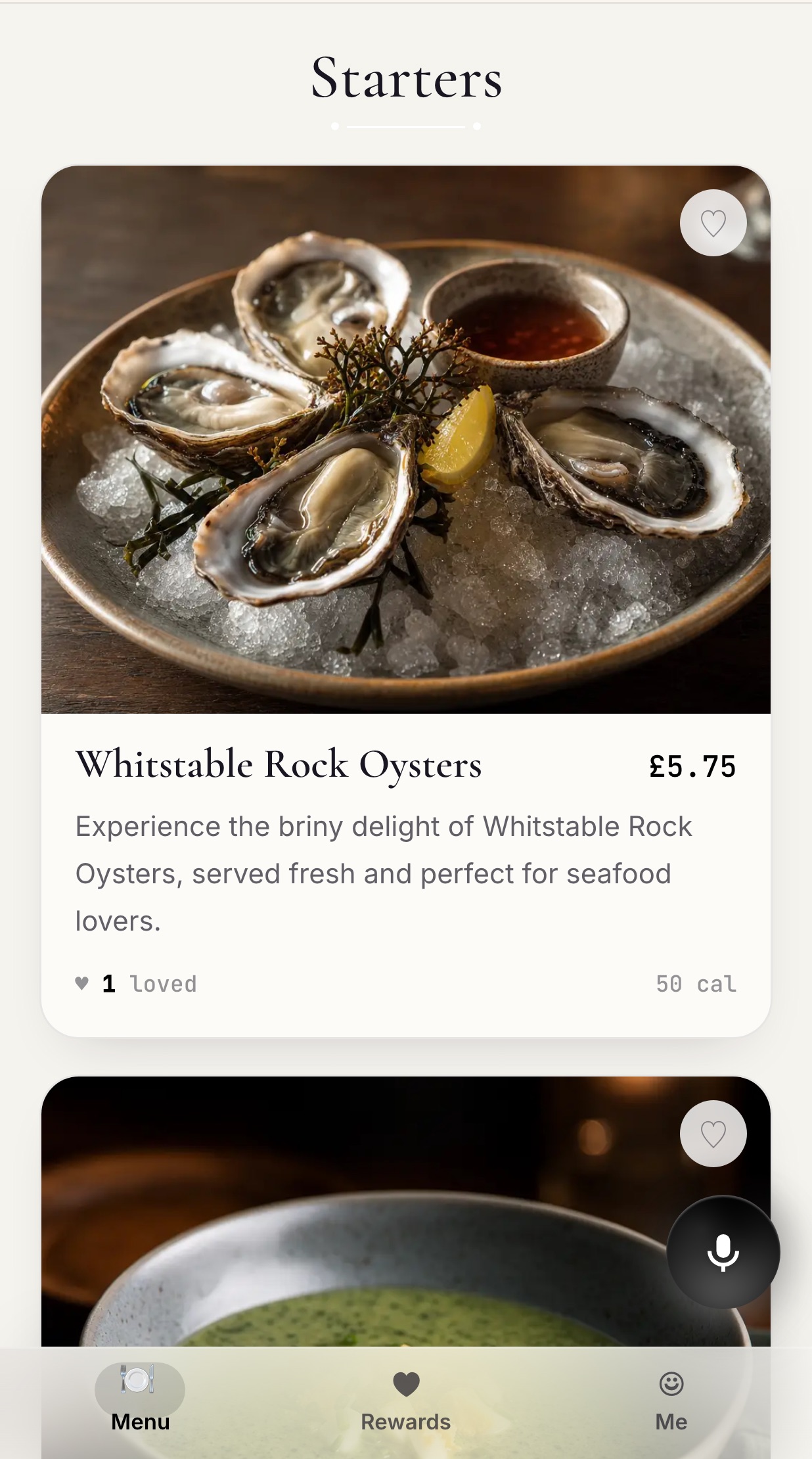
One QR on the table, or one link in your bio, opens your menu on any phone — in your colours, with no app to download. Every dish photographed, allergens on every dish, and where a dish has video, it plays. Orders go straight to the kitchen screen, email and a printed ticket.
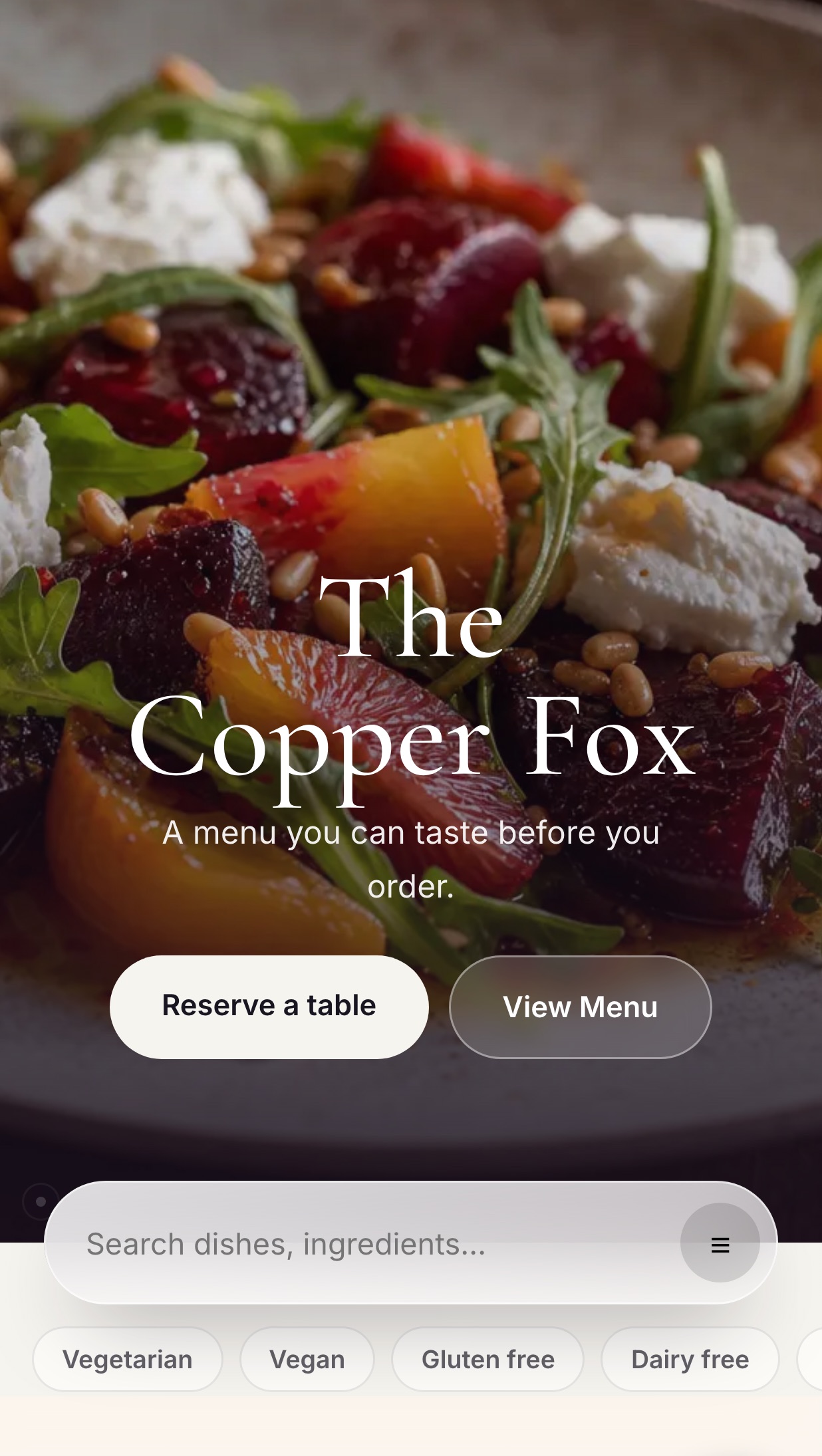
They arrive already sold. Your name, one photograph that does the selling, Reserve a table before they have scrolled — and the dietary filters right there: vegetarian, vegan, gluten-free, dairy-free, one tap each. It reads in the guest's own language, too.
Every dish photographed, priced, in the kitchen's own words. Guests search dishes and ingredients, tap what they love, and allergy notes travel with the order to the pass in capitals.
You change it, not us
Sold out of the halibut at eight o'clock? Change it in the console and it is gone from every phone in the room.
It works beside your till
Square, SumUp, Zettle and Epos Now carry on as they are. Keep OpenTable if you like it — you simply own the guest as well.
Built from what you have
We build the whole thing from your existing menu and website. There is nothing for you to set up.
From the table to the pass, with nothing in between
The menu5
GotRegulars · The Regulars SystemThe call you cannot take
Module · AI receptionist 24/7
The phone gets answered. Even at half seven on a Friday.
A missed call is a table someone else served. Your AI receptionist answers every call in your restaurant's name — grounded on your live menu and hours — quotes only live availability, takes the booking, and texts the guest to confirm.
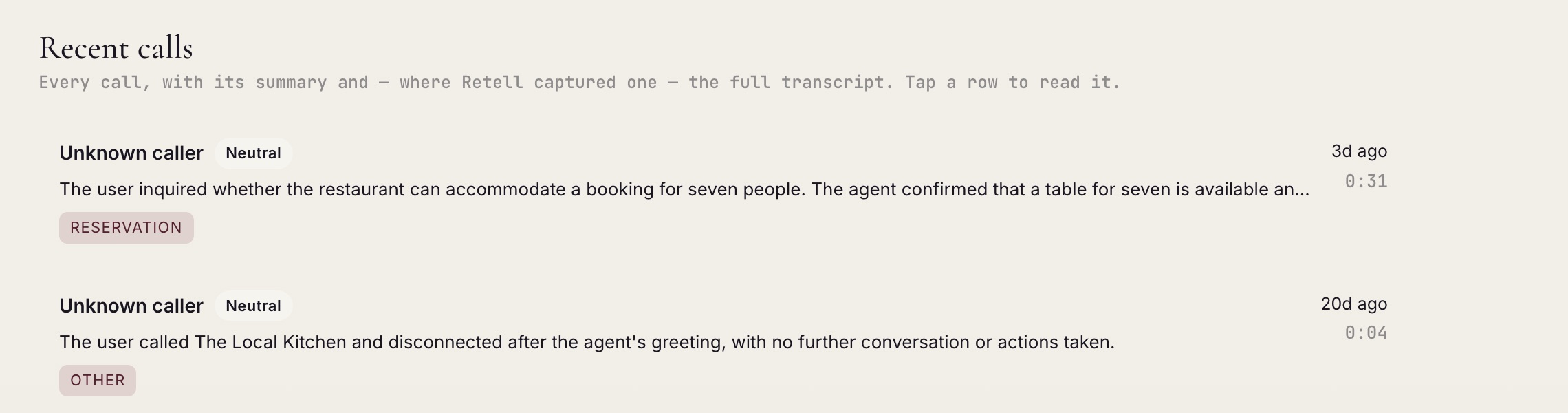
Your call record, as Monday morning reads it. Every call lands here with who called, how long it took, what they asked for and how it went. The top row is a table for seven, asked for and confirmed; the row beneath is a caller who hung up at the greeting — recorded just as plainly, because “how it went” has to mean the whole truth. It books only what your diary allows and hands anything unusual straight back to you — the caller gets a text saying the team will ring them back — and a plain-English summary of the week’s calls is emailed to you every Monday. Demonstration venue — our own test calls
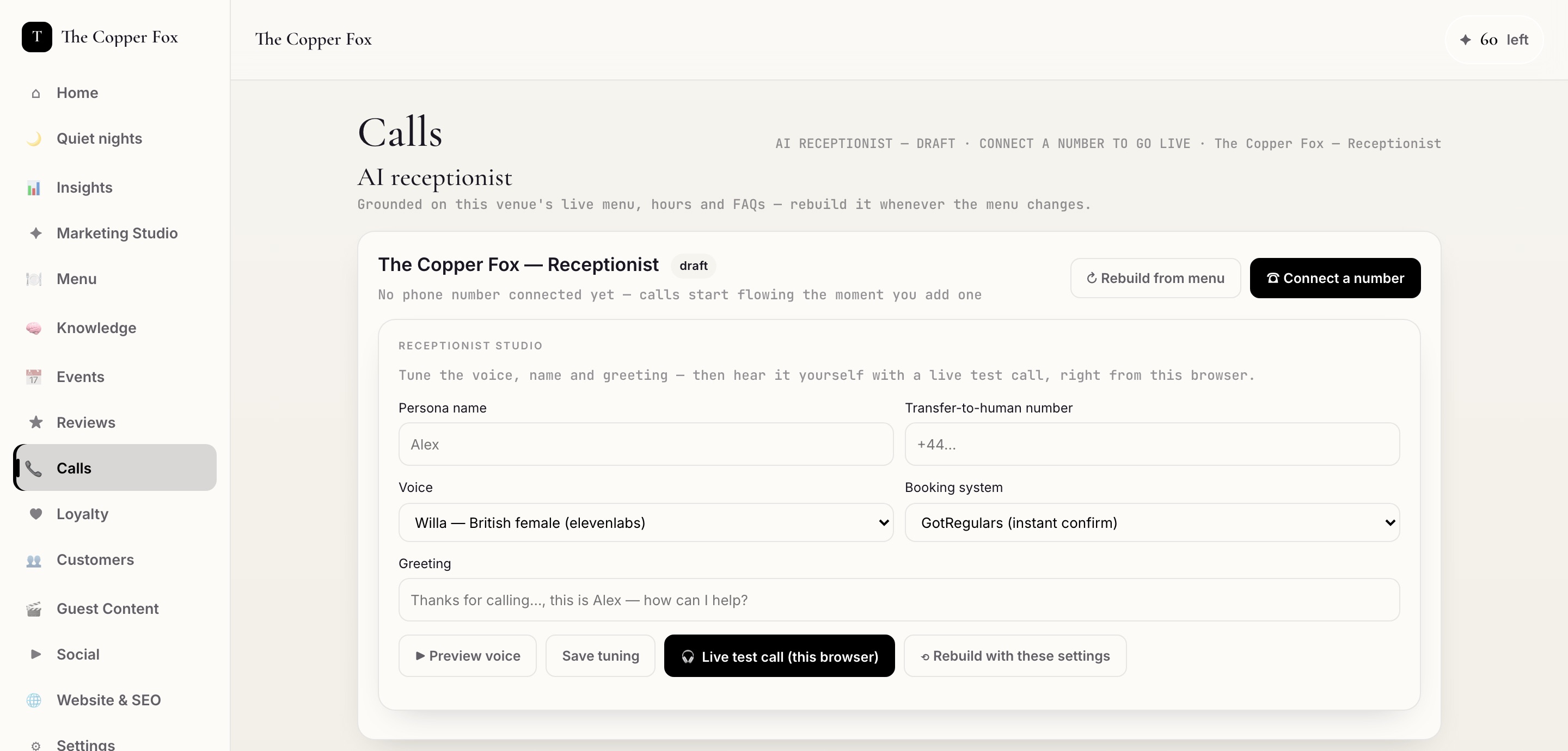
And you hear it before anyone else does. Pick the voice, write the greeting in your own words, and ring it yourself from the browser — the draft badge is the point: no phone number is connected until you have listened and said so. Demonstration venue
“I don't want a robot answering my phone.” — Fair. So listen to it first, change the words you don't like, and keep your own number pointed wherever you want until you are sure. It answers in your restaurant's name, it is a host rather than a switchboard, and you can switch it off in one tap.
The AI receptionist6
GotRegulars · The Regulars SystemThe nights that lose money
Only with everything · The quiet-nights engine
It watches your week, and fills the night that is slipping.
Not a guess about Tuesdays. It finds your genuinely slow nights from your own trading pattern — the bookings you take, or the table codes your guests open, whichever you have — and tells you what to do about them. From your first week you name your quiet nights and we build the offer together, in a few taps.
Your week against your own baseline, photographed live — read it with the three notes below. Example venue data
1
The earned line opens the page. What the quiet-day offers brought back, counted in covers against your own baseline — and it names its method in the same breath.
2
The candour is on your screen, not just in this pack. No pound figure until you tell it what a cover is worth — it says so, right there.
3
Your week, against your own normal. Green is on track, red is slipping, the marker is your baseline — here Tuesday and Saturday would get the offer.
What it will not do
It will not call a night quiet until it holds four weeks of your own trade — your bookings, or the table codes your guests scan. So it starts flagging nights by itself at about week five, and until then your console says it is still learning rather than guessing. It will not put a pound figure on a recovered cover until you tell it what a cover is worth. It will not claim a booking it cannot trace to a code or a link. Where we cannot prove it, we say so, on your own screen.
Where the offer goes
The banner and the struck-through price on your menu · a text to the regulars who opted in · a post on your Google Business Profile · and your AI receptionist mentions it to anyone who rings.
You cannot buy this on its own, deliberately: it only works when the menu, the messages and the Google posts it reaches for are all in the same hands. It is one of three things only the whole system has — alongside the monthly value statement and the Command Centre on page 12. Page 13 draws the interlock.
Quiet nights7
GotRegulars · The Regulars SystemThe week's marketing, drafted
Module · Marketing Studio
The week's posts get written for you, from your own menu.
Every Monday, five posts drafted from your real menu, your events and what callers actually asked about. You approve or edit. Nothing publishes without you.
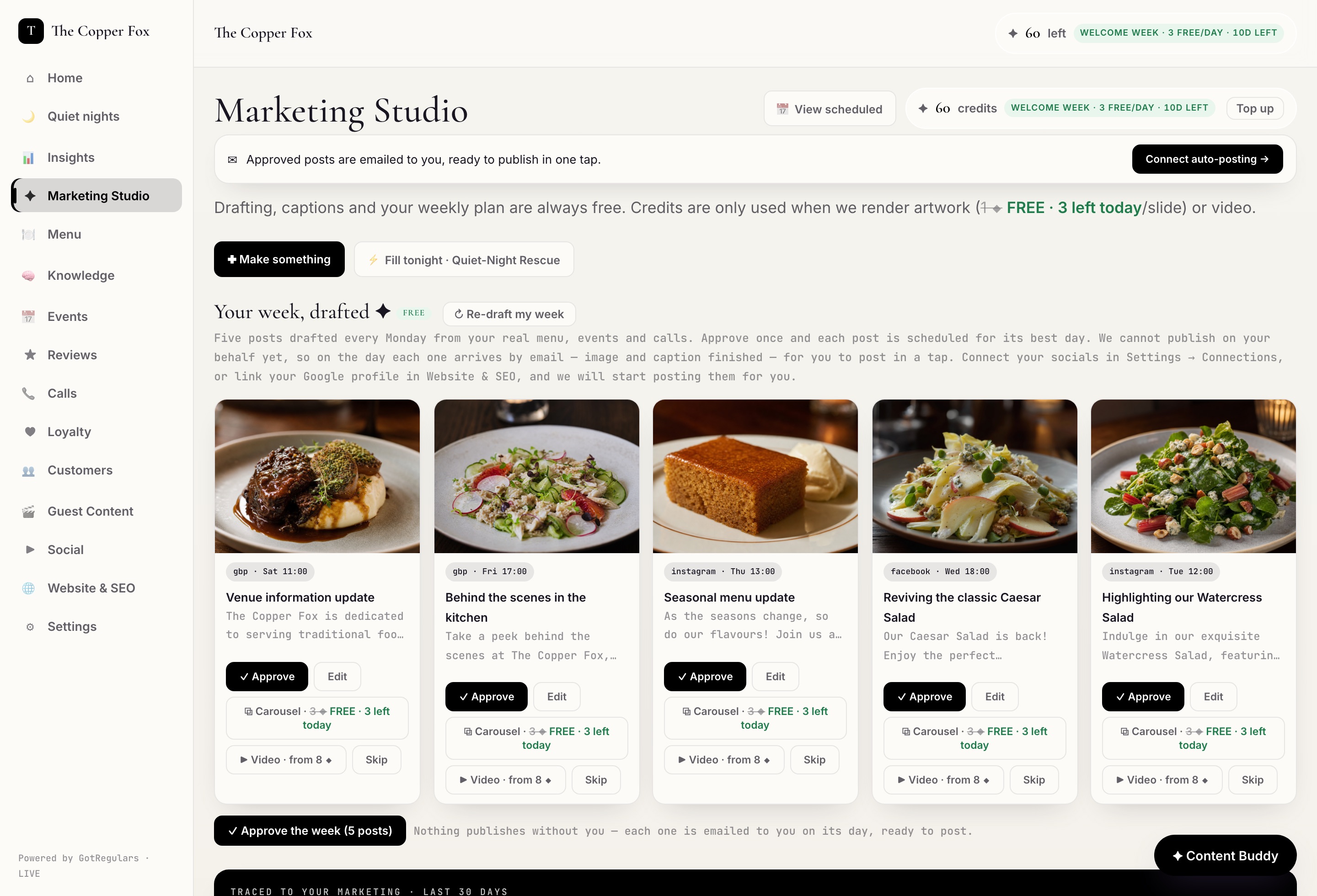
A week, drafted, before you have had coffee. Each post shows the platform and the day it is set for. Approve the lot in one tap, or edit any of them. Demonstration venue
“Nothing publishes without you — each one is emailed to you on its day, ready to post.”
The Studio's own on-screen wording, photographed above — the same candour rule as this pack
What is included
Drafting, captions and the weekly plan are always included, and images are too. Video is made on credits you buy separately — every render shows its cost before you confirm, and no video is ever free.
Where it goes
Instagram, Facebook, X and your Google Business Profile. Connect the ones you use and approved posts publish themselves; the rest arrive by email, finished, to post in a tap.
Why it is any good
Because it is written from your actual dishes, your actual events and the questions your actual callers asked last week — not from a generic restaurant template.
Marketing Studio8
GotRegulars · The Regulars SystemReputation
Module · Reviews + reputation
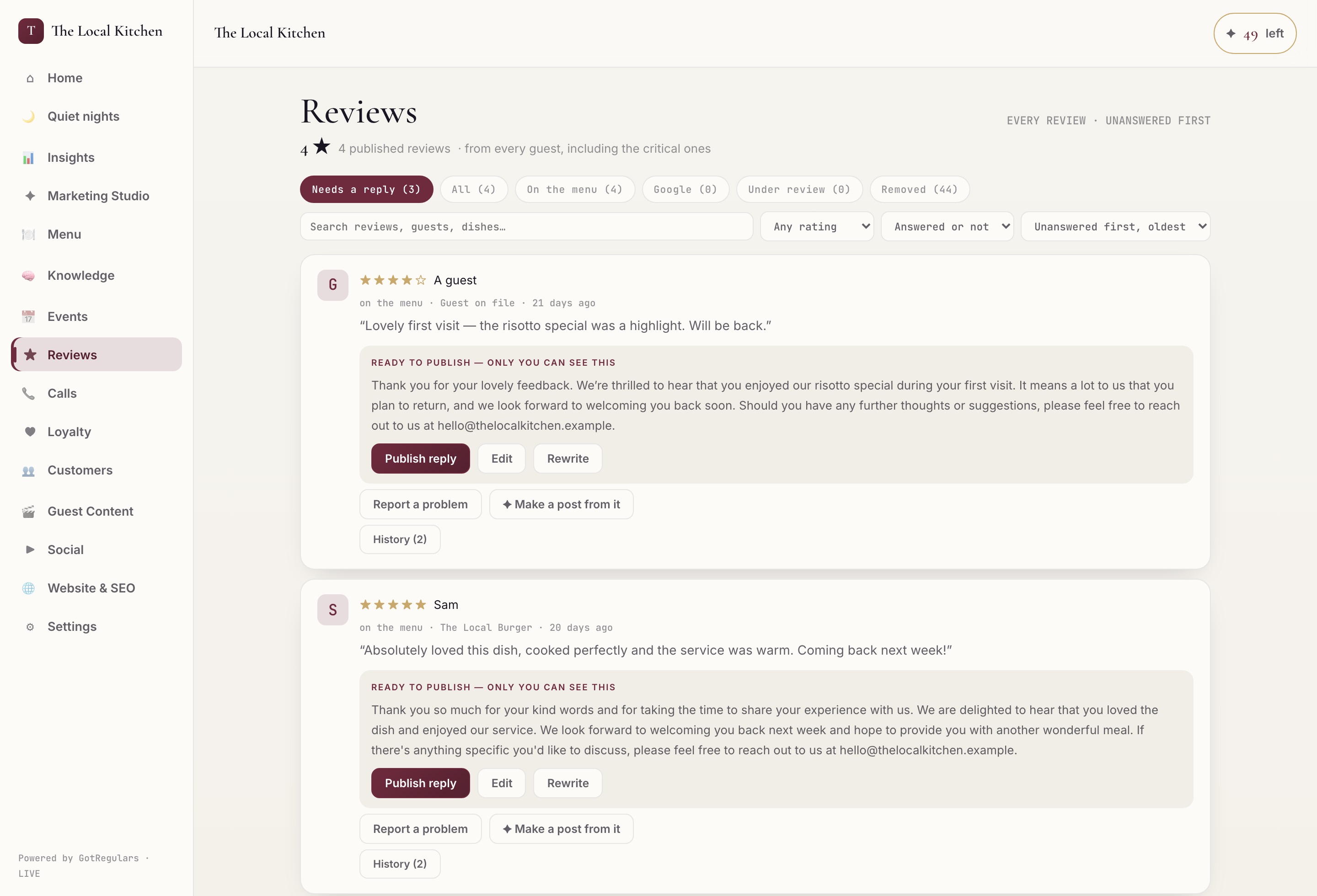
Every review answered, in your voice, the morning it lands.
Every guest asked, never only the happy ones, with a reply drafted in your voice — including the critical ones. Especially the critical ones.
Who gets asked, and when it starts. Every guest who orders or books through your QR menu, or books through your AI receptionist, and agrees to be asked, gets one message three hours after their visit. One ask, never a second, whatever they thought. It starts with the guests who arrive after you go live: we do not message your existing customer list, and we cannot reach a walk-in who never scanned. So it builds week by week rather than arriving in a lump.
A review, and its reply, already written. Each one arrives with a draft waiting — publish, edit or rewrite — the draft stays private until you act, and one tap turns a good review into a post. Example venue data
Why this is not vanity
Google's published local guidance treats reviews — and your responses to them — as a ranking and trust signal. Silence reads as decline. Our own guidance inside the product is blunt about the first ten mattering most, and the console counts them with you.
And your Google profile
Your Google reviews land in the same list as the rest, with the same drafted replies — and the autopilot on page 11 keeps the listing they sit on current, so the profile a searcher meets is never a year out of date.
Reviews9
GotRegulars · The Regulars SystemThe guest list
Module · Loyalty + guest CRM
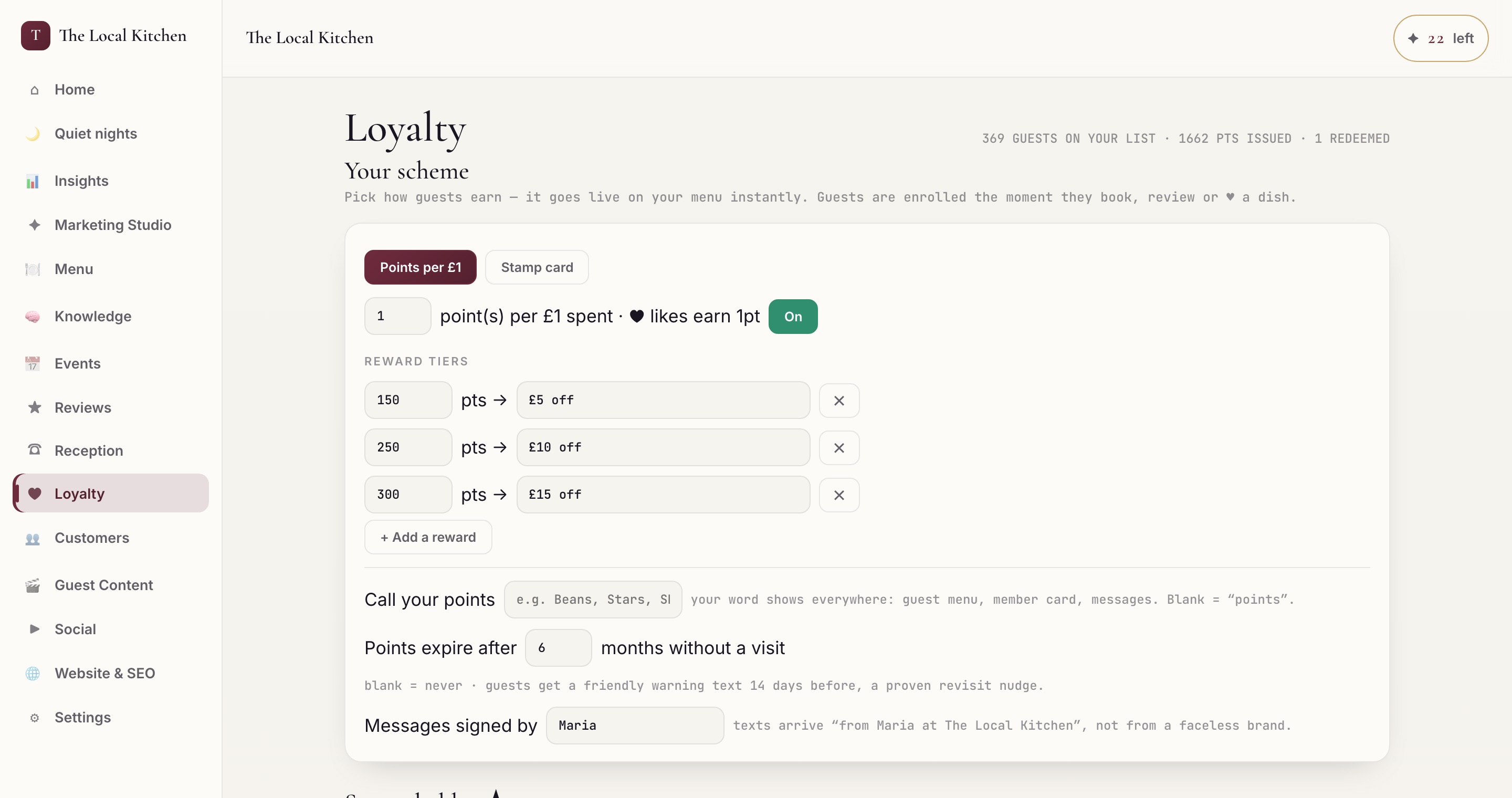
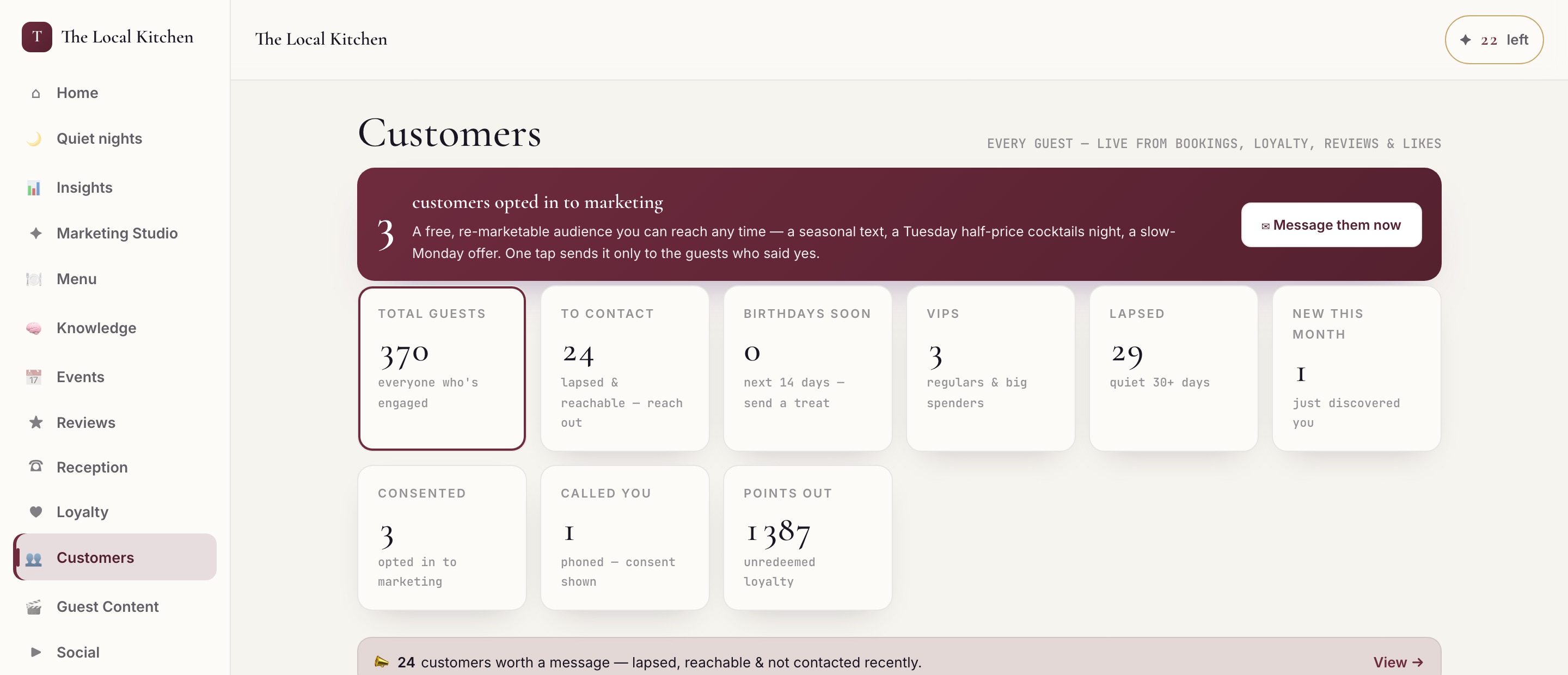
Your regulars, remembered — and one guest list feeding everything else.
Points on real money, one-tap membership, no plastic card and no app. Every booking, order, review and like builds one guest list — the same list your quiet-night offers and win-backs draw on.
You set the scheme in plain English. Points per pound or a stamp card, rewards in your own words, a nudge before points lapse — and every message signed by a person at your venue, not a faceless brand. Example venue data
The guest book sorts itself. Who is new, who is a regular, whose birthday is near, who has gone quiet thirty days — and one tap messages only the guests who said yes. Example venue data
Like reviews, this is fed by guests who book, order or scan through the system — so it builds week by week from the day you go live rather than arriving in a lump. We would rather tell you that here than have you notice it in week two.
Loyalty & guests10
GotRegulars · The Regulars SystemYour other shopfront
Module · Google Business autopilot
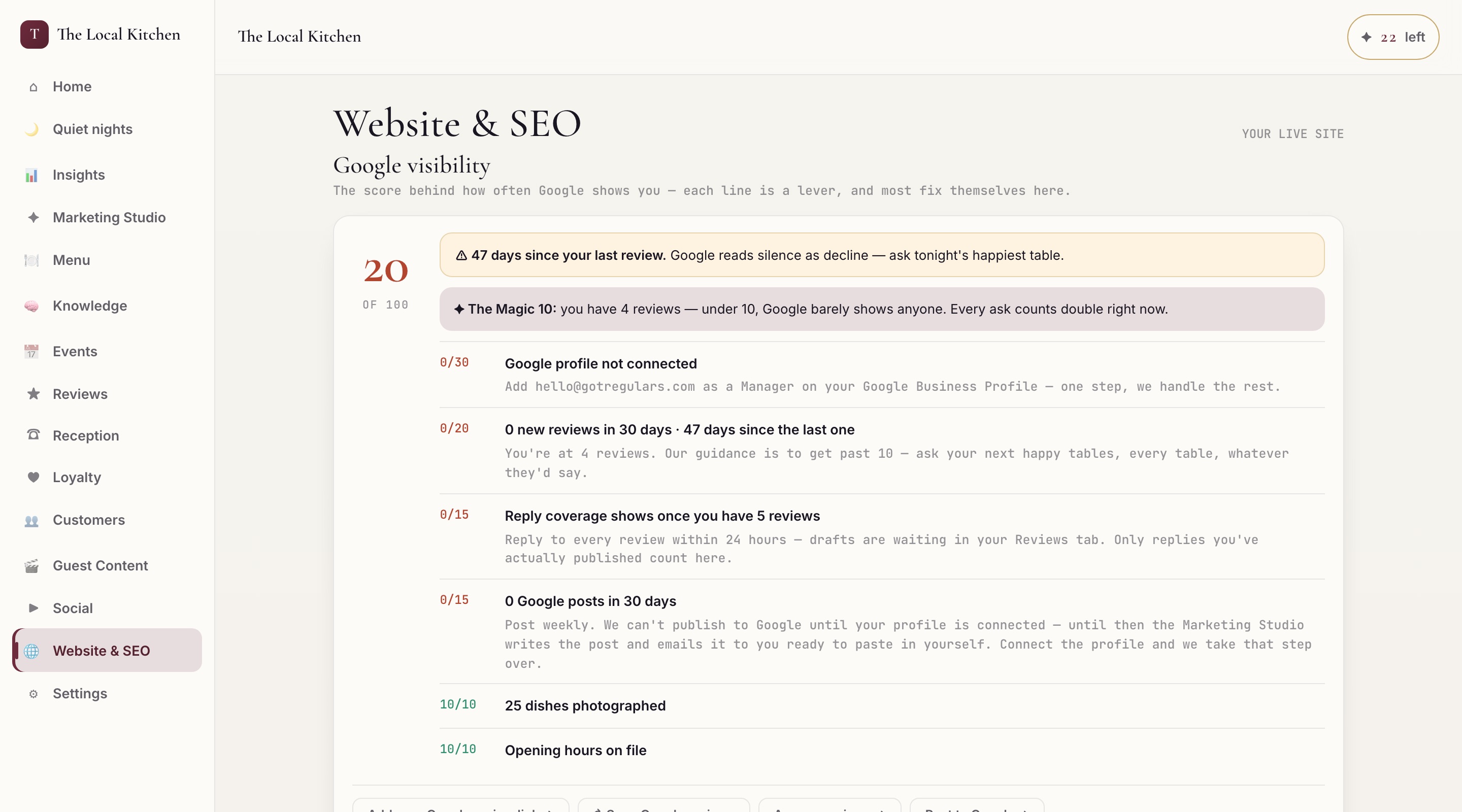
Your Google listing, kept current — without you opening it.
For most independents the Google listing is the shopfront more people walk past than the real one — and it is the one that goes stale fastest. The autopilot keeps hours, photos, posts and replies current, from the same console as everything else.
The Google side of your console. The score behind how often Google shows you, line by line — profile, reviews, replies, posts, photographs, hours — and most lines fix themselves once the profile is linked. Example venue data
One setting, thirty seconds
Add hello@gotregulars.com as a Manager on your Google Business Profile. That is your whole job — and nothing is ever posted without your approval.
Fed by the rest of the system
The posts come from the Marketing Studio, the replies from your reviews desk, the offers from the quiet-night engine. One system, posting in one voice — yours.
Why it matters
Google's own guidance says local results weigh relevance, distance and prominence, and asks for complete, accurate, up-to-date listings. A stale listing answers guests wrongly on your behalf.
And it never fights you for the keys. The profile stays yours: you remain the owner, we sit as a Manager you can remove in one tap, and every post it ever makes is one you approved. Autopilot means the work is done — not that the wheel is taken.
Google Business11
GotRegulars · The Regulars SystemEverything in one place
Only with everything · The Command Centre
One login. Everything digital about your restaurant behind it.
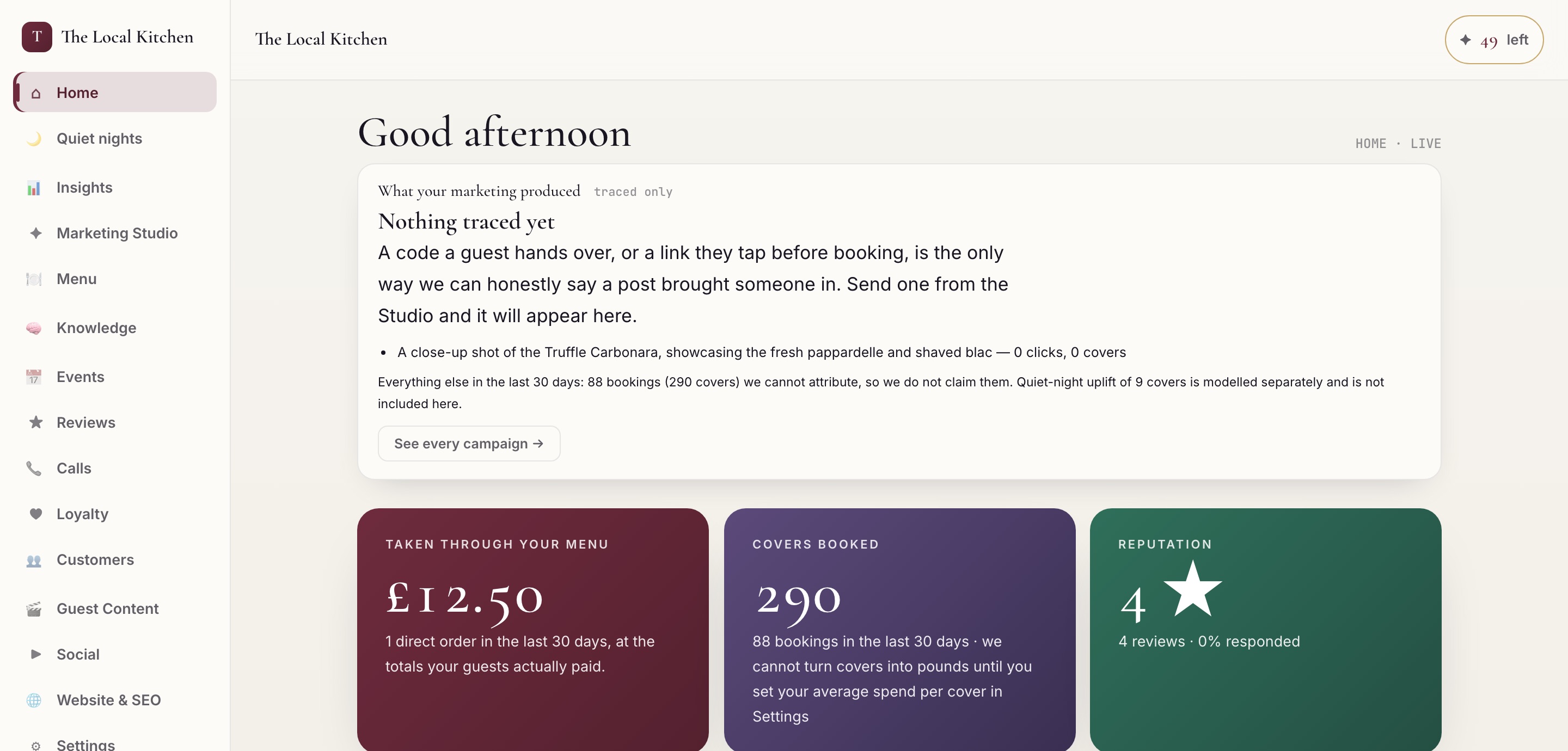
Your console on a Tuesday afternoon. Money taken through your menu, covers booked, your reputation — and, deliberately, an honest note about what we cannot attribute rather than a flattering number we cannot stand behind. Example venue data
The whole system, named
01
Premium website + SEO— built to be quoted, page 4
05
Reviews + reputation— asked for, answered, page 9
02
Interactive menu + QR ordering— to the kitchen screen, page 5
06
Loyalty + guest CRM— one guest list, page 10
03
AI receptionist 24/7— every call, in your name, page 6
07
Google Business autopilot— kept current, page 11
04
Marketing Studio— the week's posts, drafted, page 8
✦
The quiet-nights engine— only with everything, page 7
✦
The monthly value statement— in money, never estimated
✦
The Command Centre— every surface, one console
·
Live within five business days— from the day you agree
·
No setup fee, monthly rolling— cancel any time
·
The free audit, first— you see the gaps before you pay a penny
£
One monthly fee for the lot.Every module above is also sold on its own — and any three together already cost more than the whole system.
The monthly value statement counts covers booked through your diary and waits for your average spend per head from you — it shows blanks rather than guesses until it has both.
The Command Centre12
GotRegulars · The Regulars SystemWhat it costs
The fee, and the maths
One monthly fee, everything in it.
No setup fee, no build fee, no per-booking commission, no contract. Every part of the system is also sold on its own — and the arithmetic is deliberate: any three parts together already cost more than everything, so the third thing you want is the moment the whole system becomes the obvious deal.
Do the sum with your own number
One table for two, at your spend per head. How many of those tables a month would cover the whole system?
It is your arithmetic, not ours — which is why the blanks are yours to fill. Your visibility audit is free and comes first, so you will know exactly what we are quoting for before anybody talks about money.
Your spend per head
£
× two covers — one table
£
Tables a month that cover it
Worked once as an example: at £30 a head, a table for two is £60 — and for most venues a handful of £60 tables a month covers the whole system. Your exact fee is agreed once we know which parts you need, and printed on your order confirmation before you sign. If you are one of the founding fifty, that is the figure that never rises.
The founding fifty
Written into our terms, not whispered on a call: the first fifty venues to subscribe keep the fee on their order confirmation for as long as their subscription runs without a break. If our fees rise later, they rise for new venues — not for you. Fifty is a limit, not a deadline: nothing about it expires, and we publish no count of places remaining, because we do not run one.
This edition is dated, on purpose
This is the end-of-summer edition of our terms, and it stands as printed until 30 September 2026. We date it so a promise can never quietly outlive itself: if you are reading this after that date, ask us for the current edition before you rely on this one, and we will send it the same day.
Why the whole beats the basket — drawn from the code that prices it
Each arrow is a “needs” written into the module registry that prices this offer: a part whose feed is missing is quoted to you as blocked, with the reason — never silently sold. And the ladder is enforced by the same code, over every combination: any three modules together already cost more than the whole system.
The fee & the maths13
GotRegulars · The Regulars SystemGuarantees & the honest boxes
In writing, with remedies
Two guarantees with remedies attached. Three boxes most brochures leave out.
5
Guarantee one
The Five-Day Promise
You are live within five business days of the day you agree — your signature or your first payment, whichever comes first. The clock pauses only while we wait on something we have asked you for by name and in writing. We will never tell you sooner: five days is what it honestly takes to build, check and switch on.
£0
The safety
No lock-in, and the audit first
Monthly rolling after the first month, so month two is your decision and not ours — there is no contract holding you anywhere. Your data, and any number you already owned, are yours whether you stay or go.
The safety, in writing: the free audit is yours to keep either way, and nothing you sign lasts longer than a month.
If you ever leave
Your paid month finishes, then everything stays live a further fourteen days as a soft landing. Your guest data and your own phone number are exported to you and remain yours. The site, the receptionist and the engine are the service — they run while you are with us; there is no portable copy to walk away with. We would rather you knew that now than found it out later.
What we will not claim
We will not invent a client name, a testimonial or a case study, and we will not borrow one — not in this pack and not anywhere. Every claim in these pages is one of two things: a description of what the product does, which you can check against the screens photographed in it, or a measurement with its source named — our own engine, our own builds, Google's published guidance, or the public register. If a number cannot be traced to a measurement, it does not get printed. The same discipline runs the product itself: a machine compares every page of our live site, byte for byte, against the committed code, and checks that every function and database change behind it actually shipped — done is what the machine agrees is done, not what a person remembers.
What it will not do
It will not replace your till, and it does not need to touch it — orders reach your kitchen screen, a printed ticket and your inbox either way. It will not show you a revenue figure it has guessed. It will not message your existing customer list. And it will not call a night quiet, or a pound recovered, without your own data to prove it. Where we cannot prove something, your console says so — that is the same rule this pack is written under.
Three boxes set plainer than everything around them, on purpose. The guarantees get the ink; these get the plain truth — and both are part of the same offer.
Guarantees & honesty14
GotRegulars · The Regulars SystemStraight answers
The questions everyone asks
Straight answers, before you have to ask twice.
“We're doing fine — we're fully booked.”
Then the report costs you nothing and confirms it. It will still show you who owns your town's map pack, and the AI receptionist simply protects the bookings a missed call would have cost you. Leave the quiet-night side switched off until you want it.
“We've already got a website and someone who looks after it.”
Keep them. The report scores what you have got against the places round the corner, on the same checks. If it comes back strong, brilliant — hand them the fix list. This is not an argument about your website; it is about whether you are findable.
“That sounds like a lot.”
Then do it with a real number of your own: what is your spend per head, and how many extra tables a month would cover it? We set the fee once we know which parts you need, so you will be looking at a figure built for your venue rather than a list price. There is no setup fee and no contract, so it only stays if it pays for itself.
“I haven't got time to set this up.”
There is nothing for you to set up. We build it from your existing menu and site, we check it together on one call, and you are live in five business days of your agreement. Your only two jobs are naming your quiet nights and adding us on Google.
“What happens with my till?”
Nothing in this needs a connection to your till, and your till carries on exactly as it is. Orders reach your kitchen screen, a printed ticket and your inbox either way. Where a till connection is possible at all it is an extra on top, never a condition — and we will tell you the honest state of yours, in writing, before you sign anything.
“What do you get out of the founding fifty?”
A cohort. The first fifty venues are the ones we are building this company with — their rate is locked on their order confirmation for as long as they stay, which is in our terms, and in return we get the thing money cannot buy: fifty kitchens whose real weeks shape what gets built next. That is what we mean by partnership, and page 13 has the whole arrangement in writing.
“Let me think about it.”
Of course. The report is yours either way, and it does not expire. When you want the walk-through it is fifteen minutes, and you will already know what is in it.
There is one more question owners are too polite to ask, so here it is answered anyway: what happens if it does not work? You can cancel any time — nothing you sign lasts longer than a month, so the only thing keeping you is whether it is earning its keep. That is the arrangement, and it is the same for everyone.
Straight answers15
GotRegulars · The Regulars SystemWhat happens next
Five business days
If you say yes, this is exactly what happens.
Five business days from the day you agree — your signature or your first payment, whichever comes first. Page 14 has that promise with its remedy; you are needed for about forty minutes of it, in total.
1
Day 0 — we build it.From your existing menu and website. Your menu site and preview are up the same day.
2
You check it.Dishes, prices, hours, the look. Anything wrong, you fix it yourself in the console, or tell us.
3
We tune the receptionist together.Voice, greeting, what it should say. We test-call it on the phone with you listening.
4
You name your quiet nights.We set the first offer with you — three taps — and add us on your Google profile.
5
Go live, within five business days.Bookings switch over, you get your console login, and we review the first week together.
What we need from you — the whole list
About forty minutes in total — the same list the contract companion prints. Fifteen minutes on the phone — seven answers: the best mobile for the venue, the best email, your booking system by name, whether you or we confirm bookings, your till by name, your average spend per head, and your Google review link. Six minutes of your own — add us as a Manager on your Google Business Profile, and connect Instagram and Facebook if you want posts to publish themselves. One read of your own menu — prices and allergens are yours in law. And if your dishes and prices are not on your website, send us whatever you have on day one — a photograph of a printed menu is fine.
What we never touch
Your till, your suppliers, your existing booking system if you want to keep it, and your own phone number until you say so.
Who does the work
We do. There is no onboarding portal to fill in and no homework. You approve things; that is the whole of your job.
Join the founding fifty — starting is one step
Reply to the email this came with, or pick any fifteen minutes at gotregulars.com/book.
Rhys here. I run GotRegulars. We build and run the online side of independent restaurants. If you would rather start smaller, ask for your free visibility report — nothing to sign, nothing to pay, yours whatever you decide.